Views of the Solar System - Best of...
A selection of highlights from the last several years.
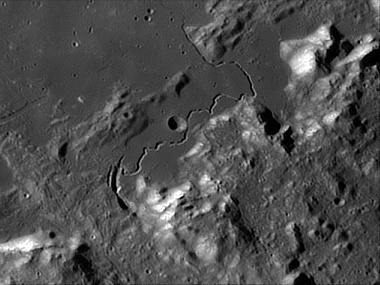
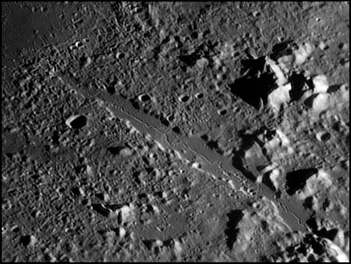
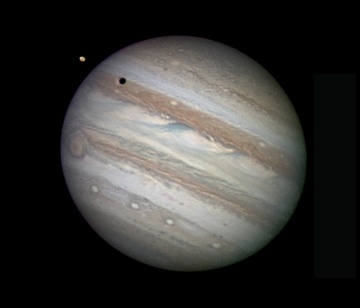
BARBADOS 2006 LUNAR CAMPAIGN. Celestron 14" Schmidt Cassegrain @ Lumenera LU075M.
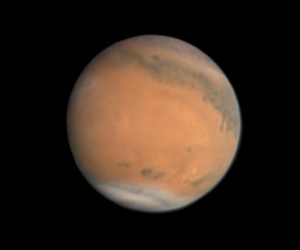
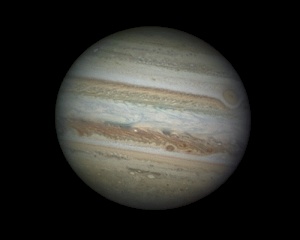
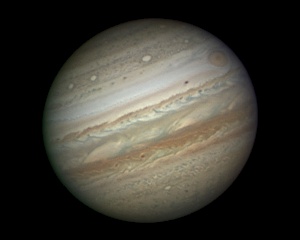
BARBADOS 2006 PLANETARY CAMPAIGN. Celestron 14" Schmidt Cassegrain @ Lumenera LU075M.
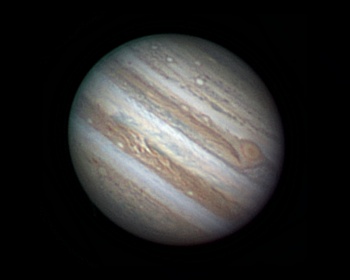
BARBADOS 2005 CAMPAIGN. Celestron 9.25" Schmidt Cassegrain @ Lumenera LU075M.

Evening Saturn
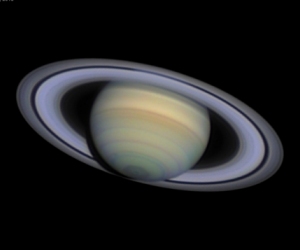
Now Saturn is 3 months past opposition, the shadow of the globe on the rings has returned. Storms are present in the atmosphere of Saturn in these images, one being a long lived event. Also note the lovely array of colours present across the Planet, and fine details within the ring system. 14" Schmidt Cassegrain @ F39. Lumenera Lu075M CCD camera. South Buckinghamshire, UK
Saturn at opposition.
Seen here three days before its opposition of the 2005/6 apparition, the rings of Saturn appear notably brightened due to the almost zero phase angle at opposition, and reduced internal shadowing within the rings. The northern hemisphere can be seen below the rings glowing a notable cyan colour due to years in darkness resulting in chemical changes in the atmosphere (note the much warmer hues of the sunlit southern hemisphere.) 14" Schmidt Cassegrain @ F39. Lumenera Lu075M CCD camera. South Buckinghamshire, UK
Mars at opposition.
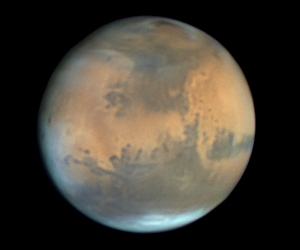
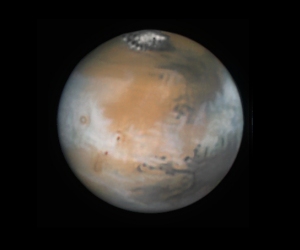
These images were taken just 10 hours before Mars reached its exact opposition point for 2005. The Planet was 70 million km distant at the time, and shining at magnitude -2.33. Though this opposition wasnt quite as close as the historic opposition of 2003, the more northern declination of Mars in the skies of northern hemisphere observers allowed much clear views of the Planet to be obtained. This view from November 6th reveals Solis Lacus, and the giant Olympus Mons volcano (prominent bright spot at upper right.) 14" Schmidt Cassegrain @ F39. Lumenera Lu075M CCD camera. South Buckinghamshire, UK
Mars grows nearer
During late September 2005 Mars started to grow to a reasonable size on its way to its closest approach at the end of October 2005. The region of Mare Cimmerium is central in this series of images across three nights, with a wealth of fine detail visible across the Martian disk The angular diameter of Mars was 16.5" at the time. 14" Schmidt Cassegrain @ F39. Lumenera Lu075M CCD camera. South Buckinghamshire, UK
Post Opposition Saturn. Saturn seen on February 7th, 2005. One of the most interesting features seen in this image, is the blue coloured Northern Hemisphere is seen glowing through the Cassini division. Imagery from the Cassini Spacecraft obtained at a similar time, confrms the strong blue colouration to Saturn's Northern Hemisphere (which is current hidden in shadow behind Saturn's rings.) When it reappears next apparition, the colouration will be much easier to see as that hemisphere emerges back into sunlight after a darkness of several years.
Celestron 9.25" Schmidt Cassegrain @ F39. ATK-1HS camera with RGB filters. South Buckinghamshire, UK
Saturn Opposition 2005. Saturn seen here 41 minutes prior to exact opposition on January 13th, 2005. The brightening of the rings that occurs at opposition, known commonly as the "opposition effect" is well apparent. This terms refers to the sudden brightening of the ring system as the phase angle reaches 0°. Internal shadows cast within the rings are at a minimum, resulting in an almost two fold increase in ring brightness very close to opposition.
Celestron 9.25" Schmidt Cassegrain @ F39. ATK-1HS camera with RGB filters. South Buckinghamshire, UK
A Colourful Saturn. Once again riding high in the winter skies, is Saturn seen here one month prior to its January 14th, 2005 opposition. Of immediate note is the wonderful coloured belts and zones seen across the Planet. The color changes we see in Saturn's banding are most likely due to small changes in the size of the aerosols at upper levels of the Saturnian atmosphere. A size change from .5 to 1.5 microns at some latitudes can reproduce colour variability. In some cases it is also possible to have changes in composition. Watch out next year as the North Polar region emerges from its long darkness - mostly likely to appear a vivid blue colour.
Celestron 9.25" Schmidt Cassegrain @ F39. ATK-1HS camera with RGB filters. South Buckinghamshire, UK
Click for full size images.
Lunar Crater Clavius with an 80mm telescope. The webcam technology of today allows not only larger telescopes to produce much more detailed images but smaller telescopes also. This view of the famous Lunar crater Clavius reveals detail to better than 1 arc second, matching the best amateur photographs of the crater from 30-40cm apertures up until the mid 1980s. Vixen FL80s @ F45. Philips ToUcam. South Buckinghamshire, UK
Click for full size images.
The Transit of Venus. For the first time since 1882, Venus transited across the face of the Sun on June 8th, 2004. The full disk view was taken near mid-transit, and shows the inky black spot of Venus on the Solar disk. The high resolution view was captured just prior to Third contact. Vixen FL80s @ F8. Philips ToUcam. Selsey, West Sussex, UK.
Click for full size images.
The eye of Mars. On August 27-28th, 2003 Mars reached its greatest angular size as seen from the Earth in 60,000yrs. The apparent diameter reached 25.1" arc seconds, and shined at a brilliant -2.9 magnitude. This view a few days before on August 22nd shows one of Mars's most prominent and historic features - Solis Lacus or better known as "the eye of Mars" for obvious reasons. 10" Meade Schmidt Cassegrain @ F55. Philips ToUcam. Observatory Roque de los Muchachos, La Palma, Canary Islands.
Click for full size images.
The Ringed Planet. Under excellent conditions Saturn is one of the most stunning sights in any telescope. This view obtained under superb conditions on Dec 16th, 2003 at the time of writing is my finest image of Saturn to date, revealing the beautiful colour shades present across the Planet. 11" Schmidt Cassegrain @ F31. ATK-1HS camera. South Buckinghamshire, UK.
Click for full size images.
Birthday Saturn!. One of the best present's for my late October Birthday, was the stunning views of Saturn in October 28th, 2003 when this view was obtained under very steady skies. Saturn often looks a very serene place, however the winds at its equator blow at over 1000mph!. 11" Schmidt Cassegrain @ F31. Philips ToUcam. South Buckinghamshire, UK.
Click for full size images.
Saturn in the morning sky. Saturn appeared again early in the morning sky of late September 2003, when this view was obtained on the 29th. The rings had closed up notably from there maximum presentation to the Earth in late Spring. 11" Schmidt Cassegrain @ F31. Philips ToUcam. South Buckinghamshire, UK.
Click for full size images.
Distant views of Mars. Its common for most to think that the period which the Planet Mars can be usefully observed is only around the period a couple of months around opposition time, however with some patience and steady seeing its possible to capture details on Mars much earlier. These views from between 8-9 months before the historic 2003 opposition of Mars, the familiar details can be seen on the red Planet despite the angular diameter being less than 5" arc seconds for all these images. Mars was around 315 million km's distant at the time of these images - by opposition day on August 27th, 2003 it has closed to just 56 million km's!. 11" Schmidt Cassegrain @ F31. SBIG ST-5c. Tenerife, Canary IsI.
Click for full size images.
A Historic Storm. The large vague Oval seen near the bottom left of these images from March 5th, 2003 show one of the largest, and most interesting storms on the Giant Planet. The large anti cyclone is infact the result of the merger of 3 such storms over the course of a few years between 1998-2000. The three Original storms collided with each other in two spectacular, never before seen events on Jupiter during spring 1998, and again in spring 2000.The storm is desginated Oval BA after BC and DE collided to form BE and BE and FA collided to form BA as seen today. See the guide section of the WebPages for more detailed information on these events. 11" Schmidt Cassegrain @ F22. Philips ToUcam. Tenerife, Canary IsI. March 2003.
Click for full size images.
A Transit of Io. On March 4th, 2003, Jupiter's volcanic moon Io transited across the cloud tops of Jupiter. In these views the tiny orange cloud of Io can be seen, showing is bright equatorial region and darker polar regions so common in spacecraft and Hubble Space Telescope imagery of this violent moon. 11" Schmidt Cassegrain @ F22. Philips ToUcam. Tenerife, Canary IsI. March 2003.
Click for full size images.
New Bright Storms Erupting. In this particular area of Jupiter near the GRS, its common to see new bright storms erupting the the Planet's South Equatorial Belt. The massive storm clouds often appear brilliant white as seen in this view from March 1st, 2003. 11" Schmidt Cassegrain @ F22. Philips ToUcam. Tenerife, Canary IsI. March 2003.
Click for full size images.
The Boring Side of Jupiter?. Every apparition of Jupiter a certain hemisphere of the Planet often presents a "less active" appearance than other regions, such as around the Great Red Spot. However, when the atmospheric seeing is steady, its clear to see from this view of February 23rd, 2004 that great amounts of activity are present on all regions of the Planet constantly. 11" Schmidt Cassegrain @ F22. Philips ToUcam. Tenerife, Canary IsI. Feb 2003.
Click for full size images.
The Great Red Spot. The most famous and largest known storm in the Solar System. This feature has been present on Jupiter since at least 1827, when the first confirmed drawing of the spot was made. Before this however, Cassini also observed a similar feature in Jupiter's atmosphere as early as the 1660s, however this can't be confirmed as the same feature, and from available data, its unlikely it was the same spot as the one we see today. During the last 120yrs, the length of the GRS has shrunk from a massive 36 degs to just 17 degs showing that the storm is slowly shrinking. 11" Schmidt Cassegrain @ F31. Philips ToUcam. Tenerife, Canary IsI. Feb 2003.
Click for full size images.
The Keeler Gap/Encke Division. One of the most challenging target's for amateur observers is making an observation or image of the fine ring division present at the outer edge of Ring A. The elusive feature is just 0.05" arc seconds in angular width (about the same size as a small coin would appear seen at a distance of 10 miles or so!.) This view from February 19th, 2003 shows the division nicely, and can only be captured under steady atmospheric conditions. 11" Schmidt Cassegrain @ F31. Philips ToUcam. Tenerife, Canary IsI. Feb 2003.
Click for full size images.
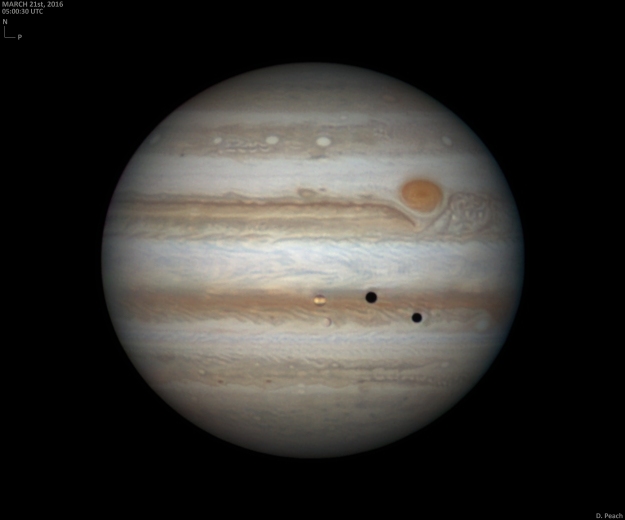
A triple transit of Jovian Moons. Every now and then its possible to see three moons in transit across the Jovian disk. On January 18th, 2003 this occured with the Planet well placed in the sky, and the event was followed with great clarity. The identifications are as follows: From Left to Right: Europa (II), Europa's Shadow, Io (I), Callisto (IV), Io's shadow. 11" Schmidt Cassegrain @ F22. Philips ToUcam. Tenerife, Canary IsI. Jan 2003.
Click for full size images.
Saturn on Christmas Eve 2002. Taken on December 24th, 2002, showing the faint belts and zones of Saturn, as well as the various ring divisions and minima present within Saturn's ring system. 11" Schmidt Cassegrain @ F31. SBIG ST-5c CCD. Tenerife, Canary IsI. Dec 2002.
Copyright © 2003-2004. www.damianpeach.com. No material used within this website may be used, amended or distributed without the consent of the webmaster.